
Subitising is the ability to recognise a small number of objects instantly, without counting them one by one.
Most adults do this all the time without thinking about it.
You see three dots on a dice and know it is three. You see two shoes by the door and know there are two. You see five fingers held up and know it is five.
That is subitising.
It matters because it helps children understand numbers as real amounts, not just words they say in order when they count.
Quick answer
Subitising means recognising a small number of objects without counting them one by one. Children might instantly recognise three dots on a dice, two apples on a plate, or five fingers on a hand. It helps build number sense, number bonds, addition, subtraction and early mental maths.
What does subitising mean?
Subitising means seeing “how many” without counting.
For example, if there are three counters on a table, a child might look and say:
“Three.”
They have not counted:
“One, two, three.”
They have simply recognised the amount.
That is different from counting. Counting is when a child touches or looks at each object and says the numbers in order. Subitising is quicker because the child sees the amount as a small group.
Both skills matter. Children need to count, but they also need to recognise small quantities and patterns.
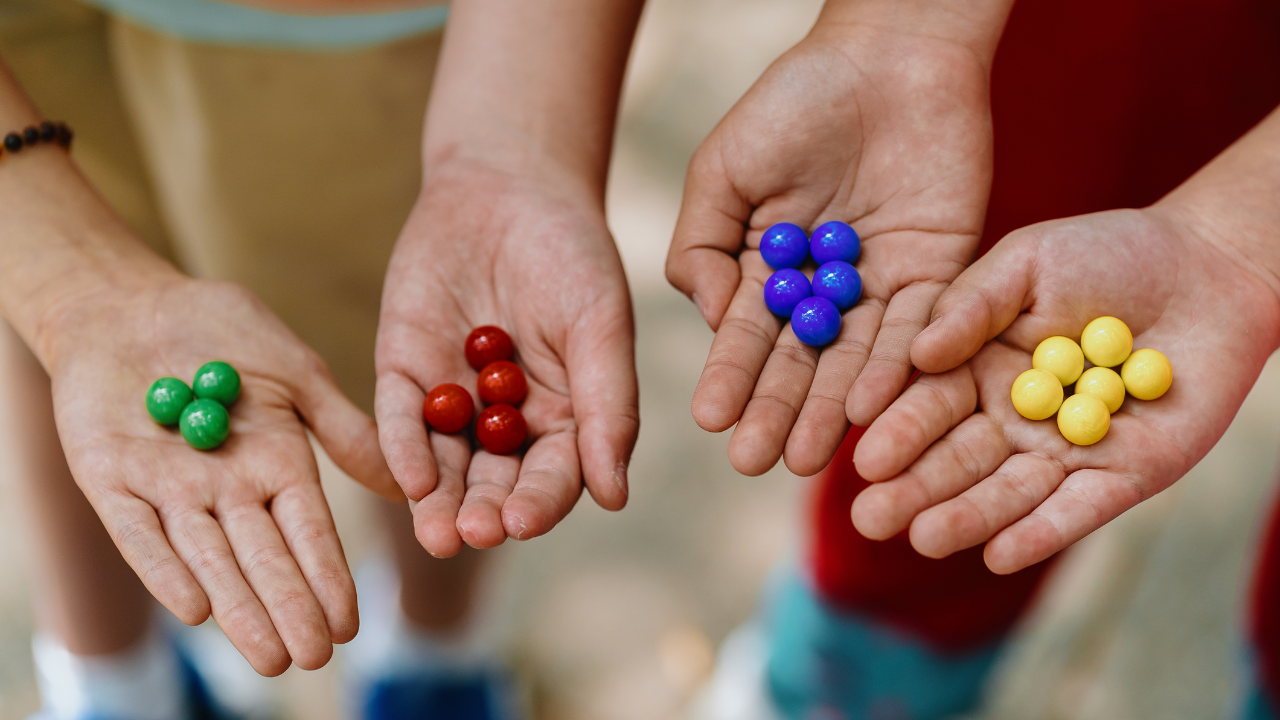
Everyday examples of subitising
Subitising happens in lots of ordinary places.
A child might recognise:
-
two socks on the floor
-
three dots on a dice
-
four buttons on a coat
-
five fingers on a hand
-
six spots on a domino
-
two apples on a plate
-
three toy cars in a row
You do not need special equipment to practise it.
If you put three grapes on a plate and your child says “three” without counting each grape, they are subitising.
Why subitising matters
Subitising helps children build number sense.
Number sense means understanding what numbers actually mean. A child might be able to count to twenty, but that does not always mean they fully understand the size of each number.
Subitising helps children see numbers as amounts.
It also helps them notice that numbers can be made in different ways.
For example, a child might see five counters and notice:
-
4 and 1
-
3 and 2
-
2 and 3
-
5 and 0
That is the beginning of number bonds.
Later, this helps with addition and subtraction because the child is not just counting everything from one. They are beginning to see useful parts inside numbers.
Two types of subitising
There are two main types of subitising: perceptual subitising and conceptual subitising.
The names sound technical, but the ideas are quite simple.
Perceptual subitising
Perceptual subitising is when a child instantly recognises a small number of objects.
This usually works best with very small numbers, such as one, two, three or four.
For example, a child sees two blocks and says:
“Two.”
They do not count each block. They just see that there are two.
This is usually the first kind of subitising children develop.
Conceptual subitising
Conceptual subitising is when a child recognises a larger number by seeing smaller groups inside it.
For example, a child might see six dots on a domino and say:
“I can see three and three. That makes six.”
Or they might see seven counters and say:
“I can see five and two.”
This is really useful because the child is starting to understand part-whole relationships. They can see that a number is made from smaller parts.
That links directly to number bonds and calculation.
How subitising helps with number bonds
Number bonds are all about seeing how numbers fit together.
Subitising helps because children start to notice parts inside a whole amount.
For example, if a child sees five as two and three, they are already beginning to understand:
2 + 3 = 5
If they see ten as six and four, they are beginning to understand:
6 + 4 = 10
This is why visual number work is so important. Children are not just memorising facts. They are building a picture of how numbers work.
How to practise subitising at home or school
Subitising practice should be short, visual and simple.
You are not trying to make children race. You are helping them notice amounts and patterns.
Here are some easy ways to practise.
Flash and hide
Put a small number of objects on the table.
Show them for one or two seconds, then cover them.
Ask:
“How many did you see?”
Start with very small amounts, such as two or three.
You can use:
-
counters
-
buttons
-
toy animals
-
cubes
-
grapes
-
pasta shapes
-
dots drawn on paper
After the child answers, ask:
“How did you see it?”
That question matters because it helps them talk about the pattern they noticed.
They might say:
“I saw two and one.”
Or:
“I saw three together.”
That is good mathematical thinking.
Use dice and dominoes
Dice and dominoes are great for subitising because the dots are arranged in clear patterns.
Roll a dice and ask:
“How many?”
At first, your child may count the dots. That is fine.
Over time, they should start to recognise the patterns more quickly.
You can also ask:
“What parts can you see?”
For example, if they roll six, they might say:
“I can see three and three.”
That is more useful than simply saying the total.
Use fingers
Fingers are very helpful for early number work.
Hold up a few fingers and ask:
“How many?”
Then ask:
“Can you show that number a different way?”
For example, five could be:
-
five fingers on one hand
-
four fingers and one finger
-
three fingers and two fingers
This helps children see that the same number can be made in different ways.
That is exactly the thinking they need for number bonds.
Use five frames and ten frames
A five frame or ten frame is a simple grid that helps children organise numbers.
A ten frame is especially useful because children can start to see numbers in relation to ten.
For example, if there are five counters on the top row and two on the bottom row, a child can see seven as:
five and two
That is much more useful than counting seven separate counters every time.
Ten frames help children move from counting one by one towards seeing number patterns.
Ask better questions
One of the best questions for subitising is:
What do you see?
Then follow it with:
How do you see it?
For example, show six dots.
One child might say:
“I see three and three.”
Another might say:
“I see five and one.”
Both answers are useful.
The total is the same, but the children are seeing the number in different ways. That helps them understand that numbers can be split and grouped.
What to avoid
Subitising should feel simple and low-pressure.
Try to avoid:
-
showing too many objects too soon
-
asking children to count every item every time
-
rushing them to answer quickly
-
treating it like a test
-
using only dice patterns
-
moving too quickly to written sums
-
correcting every answer before asking how they saw it
If a child counts the objects at first, that is normal.
You can say:
“Good counting. Now let’s see if we can spot the amount without counting each one.”
Keep it calm.
What if a child cannot do it yet?
Some children need lots of practice before they can subitise confidently.
Start smaller.
Use one, two and three objects first.
Show two counters and say:
“There are two. I can see one and one.”
Show three counters and say:
“There are three. I can see two and one.”
Model the language before expecting the child to use it.
Over time, they may begin to recognise the amount without counting.
The aim is not instant speed. The aim is steady understanding.
How subitising helps later maths
Subitising may look like a small early skill, but it supports a lot of later maths.
It helps children with:
-
number bonds
-
addition
-
subtraction
-
doubles
-
near doubles
-
making ten
-
comparing numbers
-
mental maths
For example, a child who can see eight as five and three is in a stronger position to understand:
5 + 3 = 8
A child who can see ten as six and four is starting to understand:
6 + 4 = 10
This gives children something to picture when they move on to written calculations.
Final thoughts
Subitising means recognising how many things there are without counting each one.
It helps children see numbers as amounts, patterns and parts. That makes it an important early maths skill.
Start with small groups. Use fingers, dice, dominoes, counters and everyday objects. Ask children what they see and how they see it. Let them notice different ways to make the same number.
Subitising does not replace counting. Children need both. But when children can spot small amounts and patterns quickly, numbers start to make much more sense.
Silly School Education has maths songs and videos designed to support early number sense, counting, number bonds and simple calculation. They work best alongside practical objects, visual models and short, regular practice.
Frequently asked questions
What is subitising in simple words?
Subitising means seeing how many things there are without counting each one. For example, recognising three dots on a dice straight away is subitising.
What is an example of subitising?
A simple example is looking at four fingers and knowing there are four without counting each finger.
Why is subitising important?
Subitising helps children understand numbers as quantities. It also helps them spot patterns, build number bonds, and prepare for addition and subtraction.
What age do children learn subitising?
Children often begin to subitise small amounts in the early years. They usually start with one, two and three before moving towards larger numbers and grouped patterns.
Is subitising the same as counting?
No. Counting means saying number words in order to find the total. Subitising means recognising the amount without counting each item.
How can I help my child practise subitising?
Use small groups of objects, fingers, dice, dominoes, counters, five frames and ten frames. Ask, “How many can you see?” and “How did you see it?”